
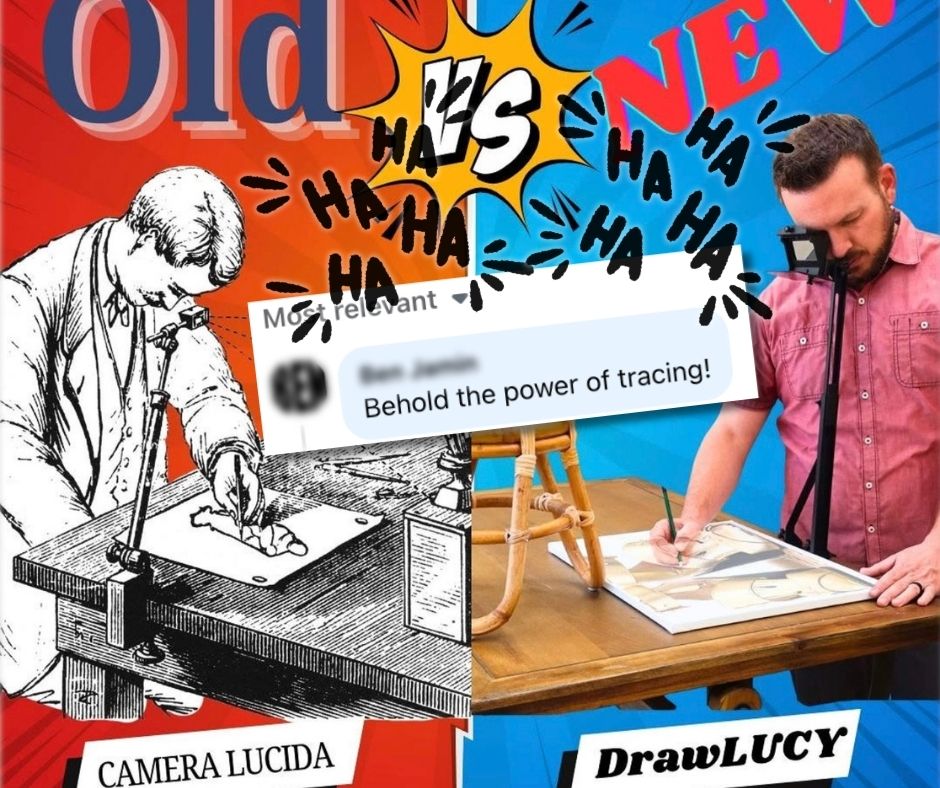
I happened to see a comment on one of our photos on Facebook that said, “Behold the power of tracing!” And honestly, we get a lot of comments like this—people who don’t appreciate or understand what the LUCY Drawing Tool is for, don’t understand (or appreciate) what the camera lucida it’s based on was, and don’t really understand the history of art or how what might be called “tracing” has played a part in learning to draw for a long time.
Let me start here: tracing is a subset of drawing. But it doesn’t apply as well in this case, because what most people mean by tracing is copying 2D over 2D—an image on a screen or a printout, onto paper. That’s not what’s happening with the LUCY. What you’re doing with the LUCY is translating a 3D world onto 2D paper, which is a little different. It’s closer to learning how to see than it is to “copy.”
The LUCY is based on a tool that has been used by artists and Old Masters for hundreds of years. So sure—you can call it tracing if you want. But artists have always used tools. Were Vermeer, Ingres, Van Eyck, Caravaggio, and Rembrandt “just tracing” because they used devices like this—of course not. The LUCY and its historical predecessors don’t do the drawing for you. It’s just a tool, and it does not remove creativity.
If anything, it puts the responsibility right back on you. Because the moment your pencil hits the paper, you still have to control your hand, make the marks, and make decisions. You still have to draw.
And here’s the bigger point: the Old Masters used these kinds of devices, and no one knows what the history of art might have looked like without them. Tools like the camera lucida weren’t some modern “shortcut.” They were part of how artists learned, trained, and produced work.
Also, the whole “tracing” insult doesn’t really hold up once you understand what the real skill is in drawing. The hard part isn’t making a line. The hard part is knowing where the line goes—seeing proportion, perspective, angles, relationships, and shapes the way they actually are, not the way your brain thinks they are.
That’s why the LUCY is such a powerful training device.
Practicing perfect makes perfect. And using the LUCY over time has a similar effect as exercises like blind contour drawing, because it forces your brain to notice what’s really there. It helps you learn how to translate a 3D world onto 2D paper. It teaches your eyes and your hand how to work together in a more honest way.
I’ve seen it personally in the most obvious way: I’m an artist. My wife is not. And it was amazing seeing a light go off in her head after using the LUCY a few times.
She started to understand perspective—like how the top of a cup is always a flatter oval than you think it is. That one little thing sounds simple, but it’s huge. Once you truly see it, you can’t unsee it. And after a handful of drawings, she was already way better than she was before, even when she wasn’t using the LUCY.
I’ve seen this again and again with other people too. The LUCY helps train you to draw what you actually see.
That’s the basis for the LUCY Drawing Course, which is now available in the LUCY Learning Hub (along with a ton more art courses and tutorials). We didn’t build that course around the idea of “tracing.” We built it around the idea of learning to see.
And we systematized it in a way that makes the improvement really obvious.
Here’s how the core exercise works:
You draw a subject totally freehand first.
Then you do three short series of quick exercises using the LUCY in a couple of different ways.
Then you draw the same subject again freehand.
And it’s honestly amazing to see the difference that learning to see with the LUCY can make in a short period of time.
And to be clear, not everyone wants that whole structured approach—and that’s totally fine. A lot of people just want a tool that helps them get proportions right, get started faster, or have more fun drawing without feeling stuck. Some people want to use it for quick sketches, some want to draw from life more accurately, and some just want a way to make drawing feel more approachable. All of those are great reasons to use the LUCY.
But no matter how you use it, something interesting happens: it nudges your brain toward seeing more accurately. You start noticing angles and shapes you used to miss. You start catching little perspective issues earlier. And over time, that carries over into your freehand drawing too.
So yeah—could a person just get the LUCY and “trace” and feel like an artist? Sure. I would still quibble with the word trace because it’s more complex than that, but either way, they’re going to be learning things whether they like it or not. You cannot draw with this device and not improve the way you see your drawing.
And if someone wants to poo-poo the idea of a “tracing tool,” they should at least recognize its history in art and its power as a teaching device before posting a snarky comment.
Unless, of course, their goal was to be the subject of a blog post.


6 comments
Josephine
@Helene / “John Wolf” Yes, the LUCY would work great for making traceable templates for carving that you can size as needed—you can even reflect the image directly onto the wood.
Josephine
@Heidelinde Crislip If you bump the LUCY, yes—if you hit it hard enough it can move, but it stays in place for normal use, and it’s easy to line back up again.
Helene
I am John. I have been a woodcarver 60 plus years. I use a pattern with a front/back and a side profile. what I hoped the Lucy would do for me, is to produce a profile on paper(traceable) from an erect object or drawing. I hoped that pattern would be able to shrink or expand. I would then be able to transfer that to a piece of wood, bandsaw the profiles and carve. Will the Lucy be able to assist me? Thank you. John Wolf
Jane
I totally agree with you! My use of the Lucy is to check my proportions. I do the drawing, check to make sure my proportions are correct, then I make the artwork mine when I paint the piece with acrylics. Because I use a tool to check the proportions, that is far from tracing.
Heidelinde Crislip
I’ve been considering this tool for some time because it would certainly speed things up. And I have read the comments for and against it. I wonder about the flexible support. Will it move when my head accidently touches the viewing piece? I would think that it would alter the alignment and that could be a problem.
Leave a comment
All comments are moderated before being published.
This site is protected by hCaptcha and the hCaptcha Privacy Policy and Terms of Service apply.