
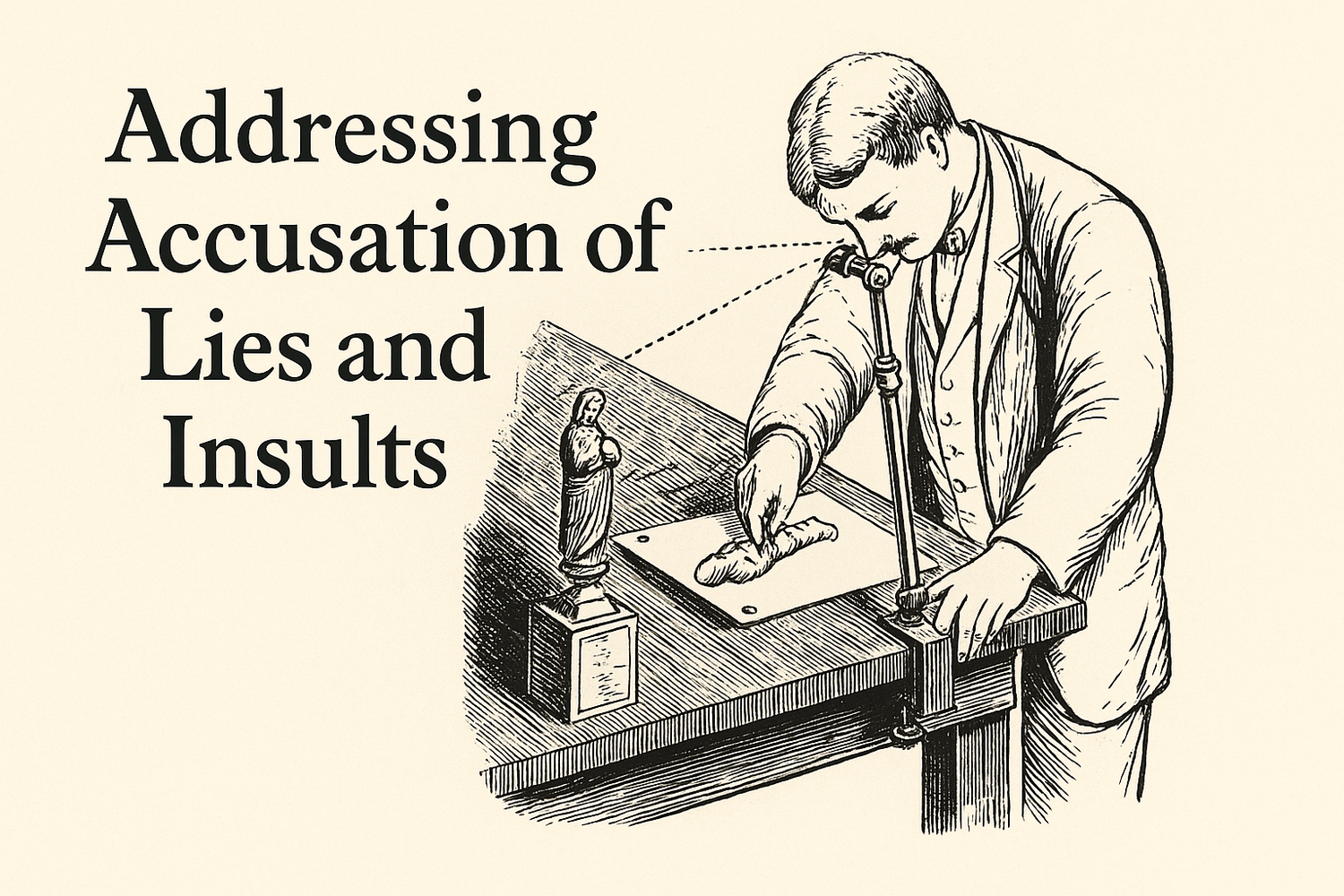
Ce matin, je réfléchissais à quelques idées de nouveau billet de blog quand j'ai été distrait et que j'ai commencé à répondre à un commentaire Facebook sur mon précédent article : « Peut-on vraiment « tricher » en art ? ». Le commentaire se lit comme suit :
« Une lucida n'est pas de la triche. On peut voir la différence quand quelqu'un avec du talent et de la formation l'utilise, comparé à quelqu'un qui n'en a pas. Ce que je trouve répréhensible, ce sont vos mensonges constants et flagrants sur qui les a utilisés. La Lucida n'a pas été inventée avant 1806.
Aucun des « vieux maîtres » ne l'a utilisée.
Ingres ne l'a pas utilisée. Il avait du talent.
Arrêtez d'insulter les gens talentueux, s'il vous plaît. »
Alors que mon esprit commençait à décortiquer le commentaire, j'ai réalisé que j'avais trouvé mon prochain sujet de blog. Parfois, embrasser une distraction est la chose la plus productive à faire.

Je n'ai aucun problème avec la première partie du commentaire, ils expriment leur opinion sur la triche en art — c'est tout à fait normal et bien. Mais ensuite, ils passent abruptement à m'accuser et/ou accuser ma compagnie de mensonges flagrants et répréhensibles. Puis, en se contredisant, ils affirment que mentionner les outils qu'un artiste a pu utiliser est une insulte envers eux. C'est ce que j'aimerais décortiquer et aborder.
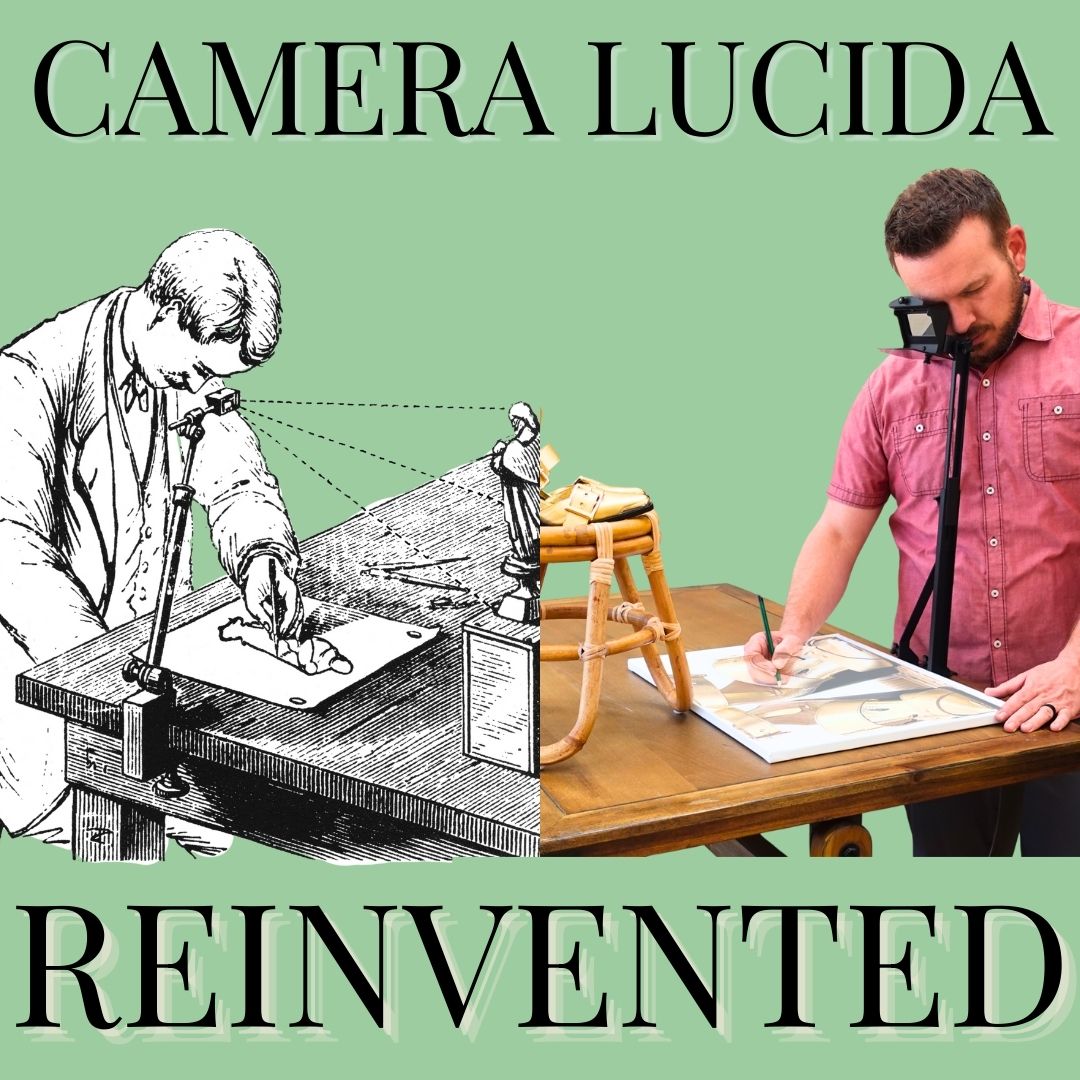
De la même manière que mon fils adolescent corrige constamment ses jeunes frères et sœurs sur chaque déclaration triviale ou perçue comme incorrecte, ce commentaire soulève un point pertinent. L'outil de dessin LUCY est une chambre claire améliorée. La chambre claire n'a été inventée qu'en 1806. Le terme « Vieux Maîtres » fait généralement référence aux artistes européens les plus reconnus — qui ont travaillé entre la Renaissance et 1800. Donc, selon cette logique, aucun des « Vieux Maîtres » n'aurait pu utiliser la chambre claire. C'est techniquement vrai. Et parfois, dans la publicité, on ne peut pas régresser dans les détails obscurs du passé et en démêler chaque nuance. Mais comme mon fils adolescent, espérons-le, le découvrira un jour — plus vous apprenez, moins vous savez.
La camera lucida a été brevetée en 1806 par William Hyde Wollaston, mais les principes optiques impliqués avaient été décrits près de 200 ans plus tôt dans la « Dioptrice » de Johannes Kepler. Le moment où une chose est brevetée et le moment où elle est utilisée ou connue pour la première fois ne coïncident pas toujours, surtout lorsque l'on traite de quelque chose d'aussi fondamental que la réflexion de la lumière. Personne ne sait si quelqu'un a construit ou utilisé un dispositif réfléchissant comme ce qui est devenu la camera lucida avant Wollaston, mais il n'y a aucune raison qu'ils n'auraient pas pu le faire.
Et bien sûr, la connaissance et l'utilisation de la camera obscura remontent encore plus loin et englobent toute l'ère de la Renaissance des « Vieux Maîtres », lorsque Léonard de Vinci esquissait des centaines de diagrammes de la camera obscura, y compris celui ci-dessous. La camera obscura est un prédécesseur de la camera lucida. Dans les deux cas, « camera » signifie chambre ou pièce. « Obscura » signifie sombre. « Lucida » signifie lumière. Le nom camera lucida a été choisi à la fois pour rendre hommage à son précurseur et pour juxtaposer le fonctionnement des deux appareils.

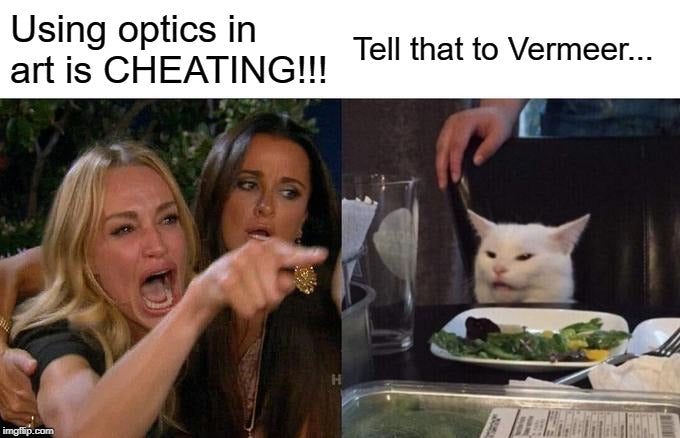
Le fait est qu'il n'y a pas un seul type d'appareil optique utilisé en art, mais une myriade de méthodes et d'outils fabriqués et utilisés au fil des siècles. C'est pourquoi nous distinguons les classes d'appareils comme les chambres claires et les prédécesseurs comme les chambres noires lorsque c'est possible ou [afin d'éviter d'entrer dans des détails confus et inutiles] nous utilisons des termes généraux tels que « des outils comme celui-ci » ou « des dispositifs similaires ». L'outil de dessin LUCY n'est pas la chambre claire inventée en 1806, la chambre claire de Wollaston n'est pas non plus une chambre noire, et la chambre noire décrite par Léonard de Vinci n'est pas la même que celle que Vermeer aurait utilisée, mais on ne peut pas rejeter les preuves de l'utilisation de l'optique en art en mélangeant et en chipotant sur quel outil a été utilisé par qui et quand. Le commentateur n'aime peut-être pas ou n'est peut-être pas d'accord, mais notre affirmation et notre conviction que les grands artistes du passé ont utilisé des outils comme celui-ci n'est pas plus un mensonge que leur insistance à dire qu'ils ne l'ont pas fait. Une certaine quantité de preuves existe, et les gens se font leur propre opinion sur ce qui a pu ou non se passer dans le passé. C'est ainsi que fonctionne la science historique.
Revenons maintenant rapidement à l'idée que parler de l'histoire de l'optique en art est en quelque sorte « insulter les personnes talentueuses ». Ce commentateur reconnaît d'abord qu'il peut faire la « différence quand quelqu'un avec du talent et de la formation utilise » une chambre claire, inférant que même si un artiste utilise ce genre d'outils, il a toujours besoin de talent et de formation pour produire un travail exceptionnel. Le commentateur se retourne ensuite et infère que notre affirmation qu'un artiste talentueux et formé a pu utiliser un dispositif optique pour l'aider à créer son œuvre exceptionnelle est « insulter les personnes talentueuses ». On ne peut pas avoir les deux. Bien sûr, l'utilisation de l'un de ces outils exige toujours du talent et de la formation, de la pratique et de la patience. Cette accusation d'insulter les personnes talentueuses est sans fondement. Donner aux gens des outils pour les aider à réaliser leur plein potentiel n'est pas de la triche et reconnaître les outils qui aident à atteindre la grandeur n'est pas une insulte.
J'ai dit mon mot. Je n'ai aucun problème avec les opinions ou les croyances différentes. Lisez et faites des recherches, posez-vous des questions et explorez ; pensez ce que vous voulez. Mais si vous m'accusez de mentir, vous pourriez obtenir une réponse prolixe 😉.


59 commentaires
Ray Vanneman
Sometimes “art” is not art at all, its an expression of love intended to stimulate the imagination of others. I am no artist, but when I realized that my kids teacted to characters their size, i began making wooden 4 foot characters that seemed to inspire them! I would present them on their birthdays as a party decoration. Thirty years later they still have them. They were always a hit. They were recently collected and used as decoration for a parade float. Most were hauled off to show-and-tell. Almost always they wanted to read more about the character. My son even went on to major in art and has worked on many of the cg scenes in the Marvel movies.
Now my grandchildren are starting to arrive i got the Lucy to help me improve the drawing and speed the process up. My work may not meet the art standards, but for me it helps achieve a lasting bond and loving relationship between artist and recipient. For practical me, what more could I ask of art.
Shelley
I understand the optics that make these types of drawing methods possible were initially developed for scientific purposes. Hockney places this at early as 1420. I believe it was a Dutch scientist, also an artist bridging the two fields, that found the same ground glass lens that made both telescope and microscope possible also gave us this tool for capturing the world as it was for the first time.
Astonishingly, later, the individual who first developed what we now know of as chemical photography in 1841, William Henry Fox Talbot, was driven to do so because he couldn’t make good enough images with the Lucida.
Paraphrasing Goethe’s prescience, “…Tools will not allow artists to create works of equal value …because a tool is not a creator.”
Blackbearybears
Great article, thank you for sharing! I too have wondered about this being a “cheat” tool. Then I noticed mural artists using a projector which projected their image onto the wall which they traced and later painted. Googling some of these devices reveals many artists (including masters) used a variety of tools to “project” an image onto their canvas. Art is more than drawing out the thing you want to paint, composition and values are huge. I do wonder about the software “Procreate”, is that cheating? Or what about AI, is that art or is that cheating?
Paula
Tools are exactly that .. tools. Even when I have attempted to sketch and paint a scene from someone’s photo or a drawing, the end result is always going to be different from theirs, most often vastly so.
Kudos on such a fabulous article and a subject that needed addressing.
Robin Barnhart
I’ve been able to draw all my life. With time and practice, these skills increase. I purchased one of these when you first started selling them and have only used it a couple of times. It did not stop my talent or increase it. It just help speed up the original drawing process.
All His blessings,
robin
Laisser un commentaire
Tous les commentaires sont modérés avant d'être publiés.
Ce site est protégé par hCaptcha, et la Politique de confidentialité et les Conditions de service de hCaptcha s’appliquent.