
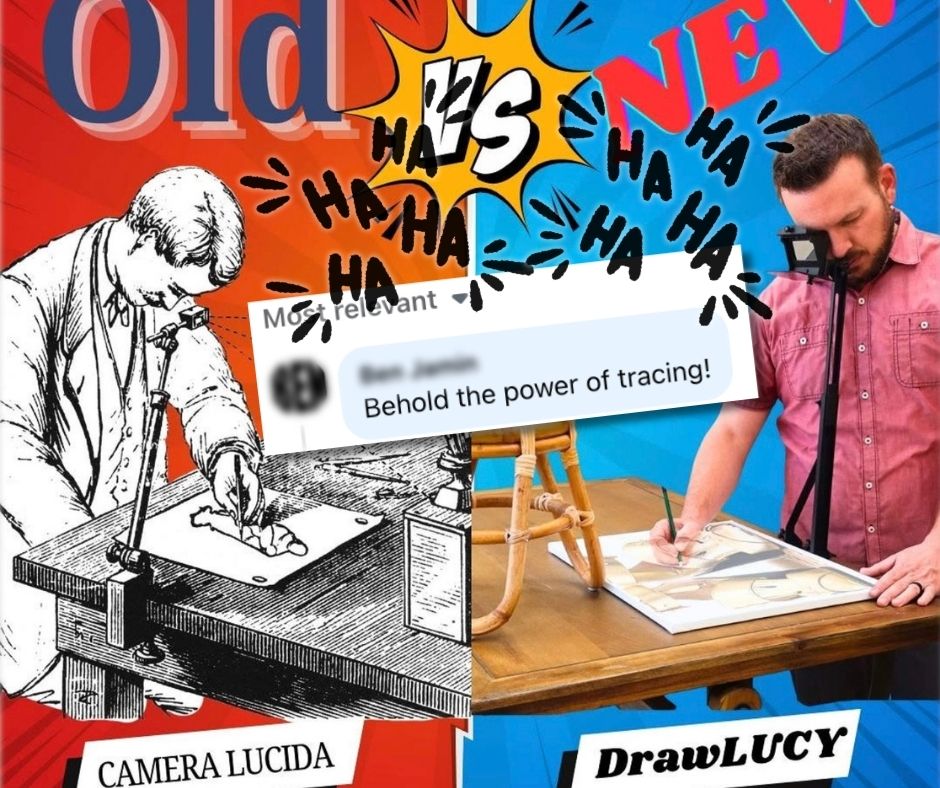
Ich sah zufällig einen Kommentar zu einem unserer Fotos auf Facebook, der lautete: „Seht her, die Macht des Nachzeichnens!“ Und ehrlich gesagt bekommen wir viele solche Kommentare – Leute, die nicht zu schätzen wissen oder verstehen, wofür das LUCY Zeichenwerkzeug da ist, nicht verstehen (oder schätzen), was die Camera lucida, auf der es basiert, war, und die die Kunstgeschichte oder die Rolle des „Nachzeichnens“ beim Erlernen des Zeichnens über lange Zeit hinweg nicht wirklich verstehen.
Lassen Sie mich hier beginnen: Nachzeichnen ist eine Untergruppe des Zeichnens. Aber es trifft in diesem Fall nicht so gut zu, denn was die meisten Leute mit Nachzeichnen meinen, ist das Kopieren von 2D über 2D – ein Bild auf einem Bildschirm oder Ausdruck auf Papier. Das ist nicht das, was mit der LUCY passiert. Was Sie mit der LUCY tun, ist die Übersetzung einer 3D-Welt auf 2D-Papier, was etwas anders ist. Es ist näher daran, sehen zu lernen, als nur zu „kopieren“.
Die LUCY basiert auf einem Werkzeug, das seit Hunderten von Jahren von Künstlern und alten Meistern verwendet wird. Also klar – Sie können es Nachzeichnen nennen, wenn Sie wollen. Aber Künstler haben schon immer Werkzeuge benutzt. Haben Vermeer, Ingres, Van Eyck, Caravaggio und Rembrandt „nur nachgezeichnet“, weil sie solche Geräte benutzten – natürlich nicht. Die LUCY und ihre historischen Vorläufer zeichnen nicht für Sie. Es ist nur ein Werkzeug, und es nimmt die Kreativität nicht weg.
Wenn überhaupt, legt es die Verantwortung wieder direkt in Ihre Hände. Denn in dem Moment, in dem Ihr Bleistift das Papier berührt, müssen Sie immer noch Ihre Hand kontrollieren, die Striche setzen und Entscheidungen treffen. Sie müssen immer noch zeichnen.
Und hier ist der wichtigere Punkt: Die Alten Meister benutzten diese Art von Geräten, und niemand weiß, wie die Kunstgeschichte ohne sie ausgesehen hätte. Werkzeuge wie die Camera lucida waren keine moderne „Abkürzung“. Sie waren Teil davon, wie Künstler lernten, trainierten und arbeiteten.
Auch der ganze „Nachzeichnen“-Vorwurf hält nicht wirklich stand, wenn man versteht, worin die wahre Fähigkeit beim Zeichnen besteht. Das Schwierige ist nicht, eine Linie zu ziehen. Das Schwierige ist zu wissen, wohin die Linie geht – Proportionen, Perspektiven, Winkel, Beziehungen und Formen so zu sehen, wie sie wirklich sind, nicht so, wie Ihr Gehirn sie sich vorstellt.
Deshalb ist die LUCY ein so leistungsstarkes Trainingsgerät.
Perfektes Üben macht perfekt. Und die Verwendung der LUCY über einen längeren Zeitraum hat einen ähnlichen Effekt wie Übungen wie das Blind-Konturzeichnen, weil sie Ihr Gehirn zwingt, zu bemerken, was wirklich da ist. Es hilft Ihnen zu lernen, eine 3D-Welt auf 2D-Papier zu übersetzen. Es lehrt Ihre Augen und Ihre Hand, ehrlicher zusammenzuarbeiten.
Ich habe es persönlich auf die offensichtlichste Weise gesehen: Ich bin Künstlerin. Meine Frau nicht. Und es war erstaunlich zu sehen, wie ihr nach ein paar Mal Gebrauch der LUCY ein Licht aufging.
Sie begann, Perspektive zu verstehen – zum Beispiel, dass die Oberseite einer Tasse immer ein flacherer Oval ist, als man denkt. Das klingt einfach, ist aber enorm. Wenn man es einmal wirklich sieht, kann man es nicht mehr ungesehen machen. Und nach einer Handvoll Zeichnungen war sie schon viel besser als zuvor, selbst wenn sie die LUCY nicht benutzte.
Das habe ich auch bei anderen Leuten immer wieder gesehen. Die LUCY hilft Ihnen, das zu zeichnen, was Sie tatsächlich sehen.
Das ist die Grundlage für den LUCY Zeichenkurs, der jetzt im LUCY Learning Hub (zusammen mit vielen weiteren Kunstkursen und Tutorials) verfügbar ist. Wir haben diesen Kurs nicht um die Idee des „Nachzeichnens“ herum aufgebaut. Wir haben ihn um die Idee des Sehens-Lernens herum aufgebaut.
Und wir haben es so systematisiert, dass die Verbesserung wirklich offensichtlich wird.
So funktioniert die Kernübung:
Zuerst zeichnen Sie ein Motiv völlig freihändig.
Danach absolvieren Sie drei kurze Serien von schnellen Übungen mit der LUCY auf verschiedene Weisen.
Danach zeichnen Sie dasselbe Motiv erneut freihändig.
Und es ist ehrlich gesagt erstaunlich zu sehen, welchen Unterschied das Sehenlernen mit der LUCY in kurzer Zeit machen kann.
Und um es klar zu sagen, nicht jeder möchte diesen strukturierten Ansatz – und das ist völlig in Ordnung. Viele Leute wollen einfach ein Werkzeug, das ihnen hilft, Proportionen richtig zu treffen, schneller anzufangen oder mehr Spaß am Zeichnen zu haben, ohne sich festgefahren zu fühlen. Manche wollen es für schnelle Skizzen verwenden, manche wollen genauer nach dem Leben zeichnen, und manche wollen einfach einen Weg, das Zeichnen zugänglicher zu machen. All das sind gute Gründe, die LUCY zu verwenden.
Aber egal, wie Sie es verwenden, etwas Interessantes passiert: Es drängt Ihr Gehirn dazu, genauer zu sehen. Sie beginnen, Winkel und Formen zu bemerken, die Sie früher übersehen haben. Sie fangen kleine Perspektivfehler früher auf. Und mit der Zeit überträgt sich das auch auf Ihr Freihandzeichnen.
Also ja – könnte eine Person einfach die LUCY nehmen und „nachzeichnen“ und sich wie ein Künstler fühlen? Sicher. Ich würde immer noch über das Wort „nachzeichnen“ streiten, weil es komplexer ist als das, aber so oder so werden sie Dinge lernen, ob sie wollen oder nicht. Sie können mit diesem Gerät nicht zeichnen, ohne Ihre Art zu sehen und zu zeichnen zu verbessern.
Und wenn jemand die Idee eines „Zeichenwerkzeugs“ verabscheuen möchte, sollte er zumindest seine Geschichte in der Kunst und seine Kraft als Lehrmittel anerkennen, bevor er einen schnippischen Kommentar postet.
Es sei denn, ihr Ziel war es natürlich, das Thema eines Blogbeitrags zu sein.


6 Kommentare
Josephine
@Helene / “John Wolf” Yes, the LUCY would work great for making traceable templates for carving that you can size as needed—you can even reflect the image directly onto the wood.
Josephine
@Heidelinde Crislip If you bump the LUCY, yes—if you hit it hard enough it can move, but it stays in place for normal use, and it’s easy to line back up again.
Helene
I am John. I have been a woodcarver 60 plus years. I use a pattern with a front/back and a side profile. what I hoped the Lucy would do for me, is to produce a profile on paper(traceable) from an erect object or drawing. I hoped that pattern would be able to shrink or expand. I would then be able to transfer that to a piece of wood, bandsaw the profiles and carve. Will the Lucy be able to assist me? Thank you. John Wolf
Jane
I totally agree with you! My use of the Lucy is to check my proportions. I do the drawing, check to make sure my proportions are correct, then I make the artwork mine when I paint the piece with acrylics. Because I use a tool to check the proportions, that is far from tracing.
Heidelinde Crislip
I’ve been considering this tool for some time because it would certainly speed things up. And I have read the comments for and against it. I wonder about the flexible support. Will it move when my head accidently touches the viewing piece? I would think that it would alter the alignment and that could be a problem.
Hinterlasse einen Kommentar
Alle Kommentare werden vor der Veröffentlichung geprüft.
Diese Website ist durch hCaptcha geschützt und es gelten die allgemeinen Geschäftsbedingungen und Datenschutzbestimmungen von hCaptcha.